


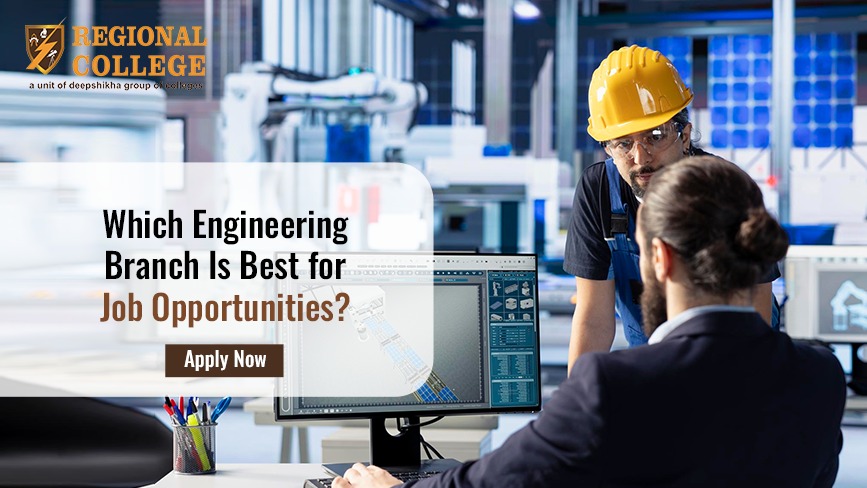
Choosing an engineering branch is a big moment in a student’s life. After finishing school, many students feel excited but also unsure. They start thinking about jobs, salary, and what kind of work they will be doing years later. Parents, on the other hand, often think about stability and long-term security. With so many opinions and so much information around, confusion is very common.
At Regional College, we meet students every year who ask the same question in different ways. Which branch will give me a good future. Some students already know what subjects they like, but they worry whether jobs will be available. Others only look at placement numbers and forget to think about whether they will enjoy the work itself. One thing is clear though. There is no single engineering branch that is perfect for everyone.
A better way to look at this decision is to ask two simple questions. What kind of work do industries need in the future, and what kind of learning suits the student.
Computer Science and Related Branches
Computer Science and related branches such as IT, AI, and data-focused programs remain very popular. This is mainly because technology is now part of almost every field. Banks use software, hospitals depend on digital systems, factories run on automation, and even small businesses rely on technology.
Students from these branches usually work in software development, testing, support roles, data-related work, or AI-based positions. One strong advantage of this field is flexibility. The skills learned here can be applied in many industries, not just one specific sector.
At the same time, students should understand that this field is competitive. Many students choose computer science, so companies receive a large number of applications. Students who actually enjoy coding, problem-solving, and learning new tools step by step usually manage better over time. Those who choose the branch only because it sounds popular may find it stressful later.
Electronics and Communication Engineering
Electronics and Communication Engineering is about how devices communicate and how electronic systems work together. In this field, students learn about circuits, signals, and communication systems.
After graduation, many students work in telecom companies, electronics manufacturing units, automation-related industries, or technical support roles. Some students also move into software or embedded system jobs after gaining additional skills.
As industries move towards smart devices and connected systems, electronics knowledge continues to be useful. This branch often suits students who like understanding how things work inside devices rather than only using technology at the surface level.
Electrical Engineering
Electrical Engineering has always been a very important branch. Power supply systems, factories and infrastructure projects. They all depend on electrical engineers.
With the constant growth in renewable energy, electric vehicles and charging stations. Fresh opportunities are constantly emerging in this sector. Electrical engineers are needed in power plants, energy sector and in many government departments.
This branch usually suits students who like core engineering subjects and who loves problem-solving. It may not look that exciting from outside, but it offers great demand and long term relevance in the market.
Mechanical Engineering
Mechanical Engineering is one of the broadest engineering branches. It covers many areas, including design, manufacturing, production, maintenance, and thermal systems.
Since the area is quite wide. Mechanical engineers often find work in areas like automobiles, manufacturing and automation departments easily. When students add skills like CAD tools, basic automation, or production planning, they usually see more job options open up.
This branch often suits students who enjoy working with machines, systems, and physical processes rather than spending all their time on computers.
Civil Engineering
Civil Engineering continues to play a major role in development and infrastructure. Roads, bridges and water supply systems. All of these require civil engineers.
Private sector work may depend on currently ongoing projects, but government often keep these projects for long term. New areas like sustainable construction and smart cities are opening up more opportunities.
Civil engineering suits those students who are interested in designing and working on large projects that people actually use in daily life.
Automation and Robotics branches
Branches which are connected to automation and robotics are getting noticed more and more. Many industries today want their work to be faster and smoother. They also want consistent quality which is very difficult to achieve without automated systems. Because of this, roles which are linked to automation are becoming more and more common.
Engineers in this area usually work around machines that operate automatically. They deal with sensors, control panels, and robotics systems that help machines perform tasks correctly.
Students whose interest lies in practical learning and like understanding how different systems connects often feel more comfortable with this field. As more companies are adopting automation, the demand for trained engineers in this area is likely to keep increasing.
Chemical and Biotechnology Engineering
Chemical and Biotechnology Engineering support important industries such as pharmaceuticals, food processing, chemicals, and healthcare. These fields focuses on safety, and controlled systems rather than on changing technology.
These branches may not attract every student, but they suit best for those who are interested in research and production work. Many students in these fields find that career growth improves even more when they go for higher studies or specialised training after graduation.
Read More : https://regional.ac.in/top-b-tech-courses-after-12th-best-engineering-programs-career-options/
So, Which Branch Is Actually Best for you?
The truth is that choosing an engineering branch can not directly guarantee you success. Job opportunities depends on many things like the skills a student have and personal interest.
Students who stay open to learning and adapt with change often performs better in any branch they are in.
Students who keep improving their skills and stay open to change usually move ahead more smoothly than those who choose a branch only because it looks safe or popular. In the coming years, industries are likely to value adaptability and willingness to learn more than fixed knowledge alone.
That is why, at Regional College, we encourage students to think carefully about what they enjoy studying and how industries are slowly changing. When a student’s interest aligns with real opportunities, growth tends to feel easier and less stressful.
Conclusion
Every engineering branch has future potential when chosen with clear understanding. Computer science, electronics, electrical, mechanical, civil, automation, and chemical branches all offer opportunities in different ways.
Instead of asking which branch is best, it would make more sense to pause and ask a much more personal question. Which branch feels right for me and what kind of future I imagine for myself.
At Regional College, our mission is to guide the students in such a way that they can make decisions with clarity and confidence, and not with pressure or confusion. With the right branch, useful skills, and steady effort, the job opportunities for future become much easier to handle.